Regional Rule Variations and Their Effects on Payout Calculations in Regulated Digital Card Platforms
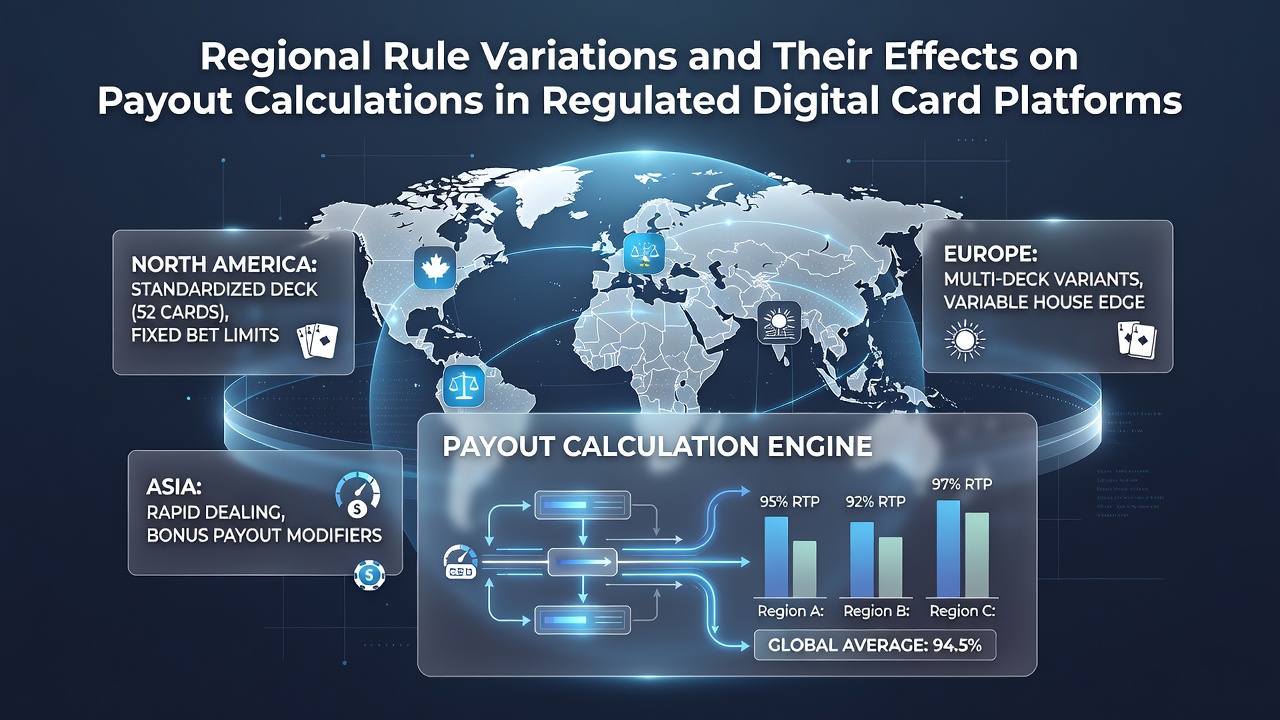
Regulated digital card platforms operate under frameworks that differ sharply by jurisdiction, and those differences directly shape payout calculations through adjustments to game mechanics such as deck counts, dealer actions, and betting limits. Observers note that platforms licensed in multiple regions must recalibrate return-to-player percentages whenever rules change, because even small modifications to hitting requirements or splitting options alter the underlying probability models used by certification labs.
Data from independent testing agencies shows that a shift from a single deck to six decks in blackjack variants can reduce theoretical payouts by 0.5 percent or more when other variables remain constant. European platforms often enforce continuous shuffling or early surrender options that North American regulators do not require, forcing operators to publish separate payout tables for each market segment. Researchers at the University of Nevada documented how these rule sets interact with random number generator certification standards to produce distinct RTP figures across borders.
European and North American Rule Divergences
European licensing bodies mandate that dealers stand on soft seventeen in many digital blackjack titles, whereas several North American state regulators permit hitting on soft seventeen. This single distinction changes payout calculations because the dealer’s improved hand strength lowers player expected value. Platforms serving both regions therefore maintain parallel rule engines and separate audit trails to satisfy each authority’s reporting requirements.
Canadian provincial regulators, including the Alcohol and Gaming Commission of Ontario, require disclosure of all rule variations before launch, which compels operators to run additional simulation cycles. Those simulations generate updated payout percentages that account for regional restrictions on side bets or maximum bet spreads. The resulting figures appear in player-facing help screens that differ by IP address detection.
Asia-Pacific Regulatory Influences
Australian digital card platforms face strict rules on automated play features and session timers that affect how payout percentages are calculated during extended sessions. The Australian Communications and Media Authority oversees these limits, and operators must demonstrate that rule adjustments do not push RTP outside approved bands. Platforms licensed in New South Wales therefore publish different payout schedules than those serving only the European market.
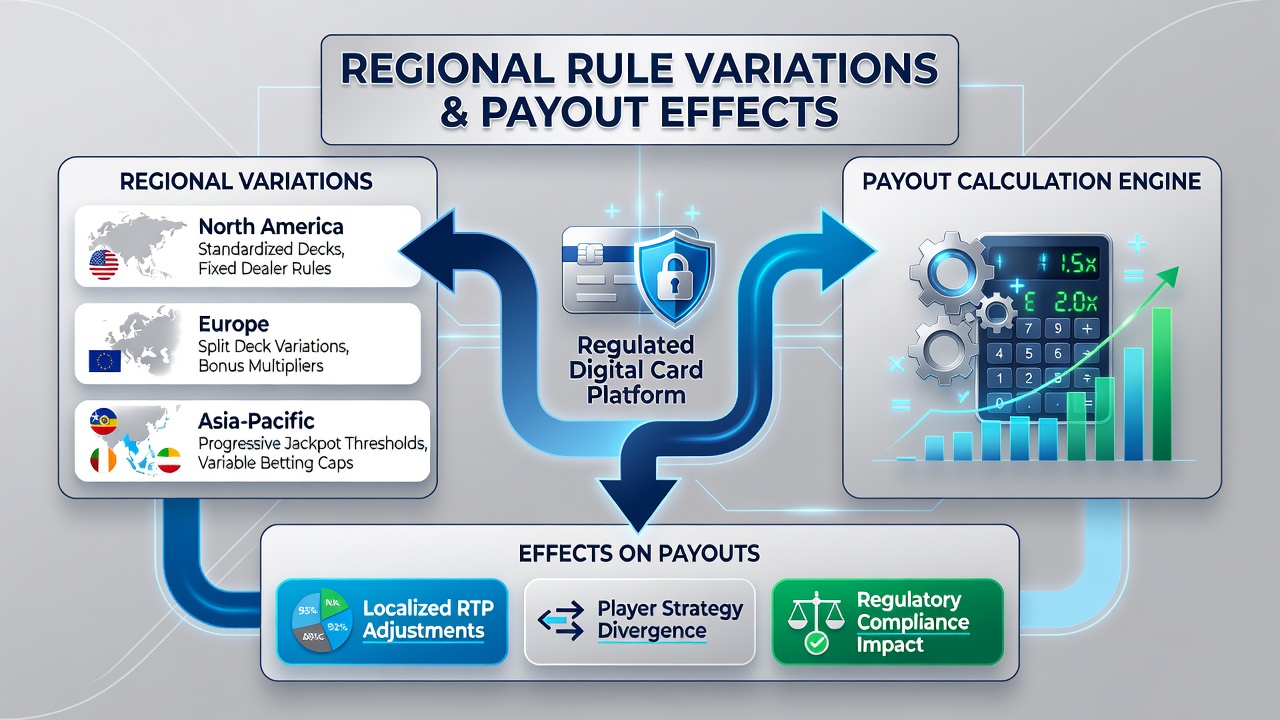
Japanese and South Korean regulators impose additional caps on progressive jackpot contributions, which directly reduces the frequency of top-tier payouts in baccarat and poker variants. Certification documents reveal that these caps require operators to lower base game RTP slightly to maintain overall house edge compliance. Players accessing platforms from different Asian jurisdictions therefore encounter distinct payout tables even when the underlying game engine remains identical.
Impact on RTP Certification and Reporting
Testing laboratories recalculate payout percentages whenever a platform adds or removes regional rule sets, because each variation modifies the combinatorial space used in Monte Carlo simulations. Figures released in June 2026 by multiple labs indicated that platforms supporting both European no-hole-card rules and North American hole-card rules required separate certification packages, increasing compliance costs and extending approval timelines.
Operators integrate geolocation services that activate the correct rule set at login, then display the corresponding payout table. This architecture ensures that a player in one jurisdiction never sees payout percentages calculated under another region’s constraints. Industry reports confirm that failure to maintain accurate regional mapping has led to regulatory warnings and mandatory payout recalibrations in several markets.
Technical Implementation Across Platforms
Backend systems store rule parameters in modular tables so that payout engines can load jurisdiction-specific values without code changes. When a new European directive alters surrender availability, developers update the parameter file and rerun certification simulations rather than rebuilding the entire platform. This modular approach allows rapid adaptation while preserving audit integrity across regions.
Payment and bonus calculations also reference the active rule set, because promotional offers tied to specific RTP thresholds must remain valid under the jurisdiction’s current parameters. Data indicates that misalignment between bonus structures and regional rules has prompted operators to segment marketing campaigns by licensing territory.
Conclusion
Regional rule variations continue to drive distinct payout calculations on regulated digital card platforms, requiring operators to maintain parallel certification, geolocation logic, and disclosure mechanisms. Regulatory updates scheduled for later periods, including those referenced in June 2026 documentation, will likely introduce further parameter adjustments that testing agencies must verify before platforms can publish revised payout tables.