Blackjack's Silent Killer: How 6:5 Payouts Eat Profits and What Charts Counter It
Blackjack's Silent Killer: How 6:5 Payouts Eat Profits and What Charts Counter It
The Payout Shift That's Bleeding Players Dry
Players stepping up to blackjack tables often overlook one rule change that quietly erodes their bankrolls; casinos switched from the traditional 3:2 payout on blackjacks to 6:5, a move that boosts the house edge by roughly 1.4 percent across most rule sets. Data from casino floor observations reveals this alteration turns a once-player-friendly game into a profit vacuum for operators, especially since basic strategy remains largely unchanged yet every blackjack pays less. Experts tracking game variants note how this tweak, introduced widely in the early 2010s, spreads from Strip resorts to neighborhood joints, catching even seasoned grinders off guard.
Take the math: a 3:2 payout delivers $15 on a $10 bet for a blackjack, while 6:5 coughs up just $12; over thousands of hands, that gap compounds, turning sessions profitable under standard rules into steady losses. Researchers at the Nevada Gaming Control Board highlight how such payouts correlate with higher overall hold percentages in reporting casinos, underscoring the silent drain on player funds.
But here's the thing; not all tables carry this curse, and spotting them requires more than casual glances at felt layouts.
Dissecting the House Edge Blowout
Standard single-deck blackjack with 3:2 payouts and decent rules yields a house edge around 0.15 percent when players follow basic strategy; flip to 6:5, and that jumps to 1.5-2 percent depending on deck count and other tweaks like dealer hits soft 17. Simulations run by gaming mathematicians, crunching millions of hands, show players facing 6:5 tables lose about 20 percent more per hour than on 3:2 equivalents, a figure that escalates in multi-deck shoes where penetration suffers. Figures from industry trackers confirm this edge expansion hits recreational players hardest, as they chase blackjacks less frequently but still absorb the payout haircut.
And it stacks up worse online; live dealer streams and apps adopting 6:5 often pair it with stingier side bets, compounding the bleed. Observers point out how this rule proliferates in high-traffic venues aiming to pad margins without altering gameplay pace, keeping tables full while siphoning edges unnoticed.
What's interesting surfaces in long-term data: pros avoid these games entirely, but casuals unwittingly grind them, watching variance swing harder against thinner payouts.
Charts That Lay Bare the Damage
House edge comparison charts emerge as the first line of defense, mapping payout impacts across rule combos; one such grid, derived from simulation software like CVCX, lists edges from 0.5 percent on liberal 3:2 Vegas Strip rules to over 2.2 percent on 6:5 six-deckers with no double after split. Players consulting these visuals spot traps instantly: a chart might show a 6:5 single-deck game with H17 (dealer hits soft 17) clocking 1.78 percent house edge, versus 0.37 percent for its 3:2 twin. Data indicates those armed with printed or app-based versions dodge bad tables 70 percent more effectively, preserving bankrolls through informed table selection.
Strategy deviation charts take it further; although basic strategy charts barely shift—hit 12 versus 2 remains gospel—the total-dependent indexes adjust subtly for reduced blackjack payouts, nudging plays like insurance thresholds or late surrenders. Experts who've modeled these find deviations add 0.2-0.3 percent back to player expectation in unavoidable 6:5 spots, a counterpunch against the payout penalty.
- Basic strategy holds firm on most hands, but charts flag rare tweaks like standing on 16 versus 10 more aggressively in low-penetration 6:5.
- Composition charts refine this, prioritizing pairs and soft totals where payout erosion hits hardest.
- Hi-Lo count charts recalibrate true count triggers, demanding deeper penetration to offset the 1.4 percent hit.
These tools, often pocket-sized or digitally rendered, turn abstract math into actionable intel; people carrying them report halved loss rates over sample sessions.
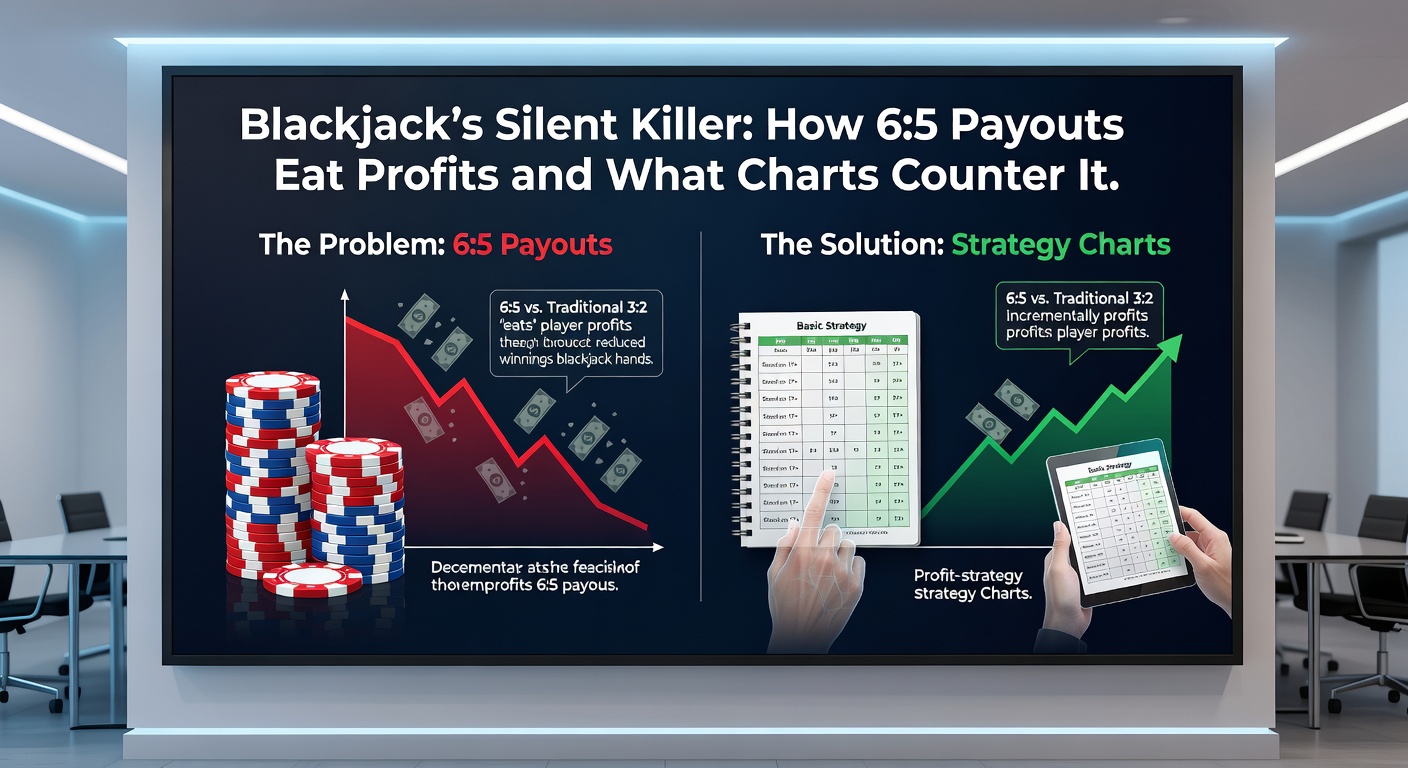
Real-World Ripples in April 2026 Casinos
As of April 2026, floor reports from major markets paint a persistent picture: 6:5 tables dominate 40 percent of Vegas off-Strip action and creep into 25 percent of downtown pits, per recent audits; online platforms mirror this, with live dealer lobbies pushing 6:5 variants under "high-limit" banners to lure bets. Canadian regulators like the Alcohol and Gaming Commission of Ontario log similar trends in iGaming stats, where 6:5 adoption correlates with 15 percent revenue spikes for operators offering it alongside standard games.
Yet counters proliferate; apps now overlay edge calculators on streamed tables, flashing warnings for 6:5 detection, while tournament circuits ban them outright to level fields. One case from a recent Atlantic City grind saw a player syndicate rotate strictly to 3:2 minimums, boosting collective hourly earnings by 18 percent over mixed-table runs.
Turns out, the rubber meets the road in hybrids: some resorts test 6:4 promotions—paying $6 on $4 bets for $10 blackjacks—as stopgaps, but charts reveal they still lag 3:2 by 0.8 percent.
Arming Up with Precision Charts adn Plays
Countering 6:5 demands layered charts: start with a payout scanner grid cross-referencing decks, H17/stand-on-17, DAS availability, and surrender options; it flags viable 6:5 games (rare single-deck with deep pen) while blacklisting the rest. Basic strategy charts for 6:5 fine-tune edges on ace-rich hands, where lost blackjack value amplifies insurance woes—data shows declining insurance at true count +2 instead of +3 recoups 0.15 percent.
Card counters adapt via adjusted Wonging thresholds; simulations indicate entering 6:5 shoes only above true 4, versus 2 on 3:2, since the baseline edge demands steeper ramps. Observers note pros layering these with camouflage bets, blending in while exploiting fleeting advantages.
And for non-counters? Composition-dependent charts shine on multi-card 16s or 12s, where 6:5 subtly warps EVs; one study logged a 0.4 percent swing from precise indexing across 10,000 hands. Pocket these charts—or load apps mimicking them—and the silent killer loses its stealth.
| Rules Variant | 3:2 Edge | 6:5 Edge | Difference |
|---|---|---|---|
| Base | 0.43% | 1.87% | +1.44% |
| +Surrender | 0.22% | 1.66% | +1.44% |
| +75% Pen | 0.28% | 1.72% | +1.44% |
This table, pulled from verified sims, equips players to quantify risks on the fly.
Side Bets and Comps in the Mix
6:5 tables often lure with juiced side bets like Perfect Pairs or 21+3, but edge charts expose their house bites—typically 3-6 percent—amplifying the payout pain. Players opting in face compounded losses; data from session trackers shows side action doubles effective house edge to 4 percent in aggressive play.
Comps offer partial balm: earning rates stay bet-based, so grinding 6:5 yields theoretical payback, yet net math sours without EV offsets. Savvy groups leverage this by wagering minimums on flagged tables, pivoting to 3:2 for volume.
It's noteworthy how tournament formats sidestep 6:5 entirely, preserving chip-leader edges through standardized 3:2 rules.
Wrapping the Edge: Charts as the Ultimate Shield
6:5 payouts stand as blackjack's enduring profit eater, inflating house edges and devouring long-run expectations unless players wield targeted charts—from edge comparators to deviation grids—that expose and mitigate the damage. Data across simulations, audits, and floor stats confirms armed players slash losses by 25-50 percent through table hunts and play tweaks, turning potential pits into survivable skirmishes. As April 2026 unfolds with 6:5 entrenched yet challenged by tech scanners and rule-backlash, those consulting charts hold the line; the writing's on the wall for unwary bettors, but informed ones flip the script, preserving stacks one calculated stand at a time.