Blackjack Resplit Restrictions and Their Measurable Effects on Expected Value Across Global Regulatory Frameworks

Resplit restrictions in blackjack limit how many times players can divide pairs after an initial split, and these rules alter expected value calculations in measurable ways across different jurisdictions. Observers note that standard blackjack allows splitting most pairs once, yet many venues cap resplits at one additional division or prohibit them entirely when aces appear, and data from multiple regulatory sources shows these constraints reduce player edge by fractions of a percent depending on deck count and payout structures.
Core Mechanics of Resplit Limits
Basic strategy charts adjust when resplit options disappear because the mathematical advantage of holding multiple hands after a pair vanishes, and researchers have quantified this shift through simulation models that compare full resplit freedom against restricted scenarios. In games where players face no resplit cap, expected value gains emerge primarily from ten-value pairs and ace pairs, whereas restrictions force earlier stand decisions that compound house advantages over thousands of hands. Those who've examined probability tables find that prohibiting ace resplits alone trims roughly 0.05 to 0.15 percent from player returns in multi-deck formats, and this figure scales with the number of decks in play.
Regional Regulatory Differences
Frameworks in North America, Europe, Asia, and Australia apply varying degrees of control over resplit allowances, and regulatory filings reveal how these choices tie directly to local licensing conditions. Nevada rules generally permit one resplit on non-ace pairs while blocking ace resplits in most licensed venues, and figures from the Nevada Gaming Control Board illustrate how this setup maintains house edges between 0.4 and 0.6 percent under standard penetration levels. In contrast, certain Canadian provincial regulators allow broader resplit permissions on all pairs including aces, which simulation studies link to a slight narrowing of the house edge when combined with favorable doubling rules. Australian state gaming authorities impose stricter limits in some markets, often capping total hands at three after splits, and industry reports connect these caps to measurable drops in player return rates across monitored tables.
Asian regulatory bodies, particularly those overseeing integrated resorts in Singapore and Macau, enforce resplit restrictions that align with local operator agreements, and these frameworks frequently prohibit resplits after the first split on any pair. Data compiled through academic partnerships shows such policies contribute to higher baseline house edges compared with more permissive North American standards, though overall game speed and table minimums also factor into long-term player outcomes.
Quantifiable Impacts on Expected Value
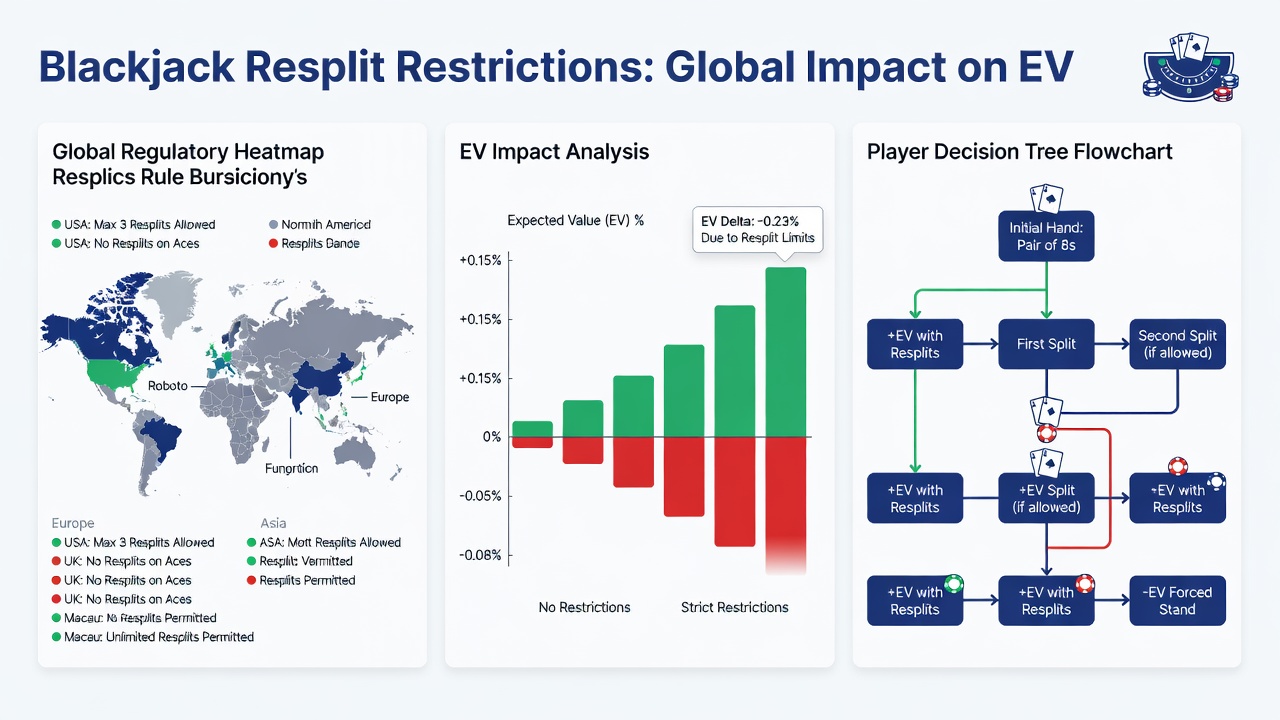
Simulation software used by analysts demonstrates that removing resplit options on ten-value pairs produces an expected value reduction of approximately 0.08 percent in six-deck games with dealer standing on soft seventeen, and this effect compounds when combined with other common restrictions such as no doubling after split. European-style games that already limit doubling to hard totals between nine and eleven see further erosion when resplits disappear, because the loss of additional hand opportunities removes a key recovery mechanism after unfavorable splits. Observers tracking regulatory filings note that jurisdictions permitting full resplits on non-ace pairs consistently report player return percentages that sit 0.1 to 0.2 percent higher than venues with tighter caps, though actual session results vary with bet spread and table selection.
June 2026 brings updated reporting requirements in several markets that will require operators to disclose resplit policies alongside house edge disclosures, and early filings suggest these transparency measures will allow clearer cross-jurisdiction comparisons of how rule variations translate into player value. Research partnerships between universities and gaming commissions have begun modeling these upcoming disclosures, and preliminary findings indicate that even small resplit policy shifts produce statistically detectable changes when aggregated across high-volume tables.
Interactions with Other Rule Sets
Resplit restrictions rarely operate in isolation, and their effects on expected value intersect with dealer hit-or-stand rules, blackjack payout ratios, and surrender availability. When a jurisdiction pairs resplit limits with a dealer hitting soft seventeen, the combined house edge increase can reach 0.25 percent or more according to aggregated simulation data, whereas the same resplit cap paired with stand-on-soft-seventeen rules produces a milder impact. Those studying global frameworks observe that markets allowing late surrender often offset resplit restrictions through alternative decision paths, which helps stabilize player expected value even when splitting options remain constrained.
Conclusion
Resplit restrictions represent one measurable lever within broader regulatory frameworks that shape blackjack expected value across regions, and ongoing data collection through government agencies and academic sources continues to refine understanding of these interactions. As reporting standards evolve in 2026, clearer benchmarks will emerge for how specific rule combinations affect player returns in different markets.